 Quantum Bias
Loss Aversion in Trading: Why Losses Hurt Twice as Much
The imbalance behind most trading mistakes, measured in the lab and on the trading floor.
In this article
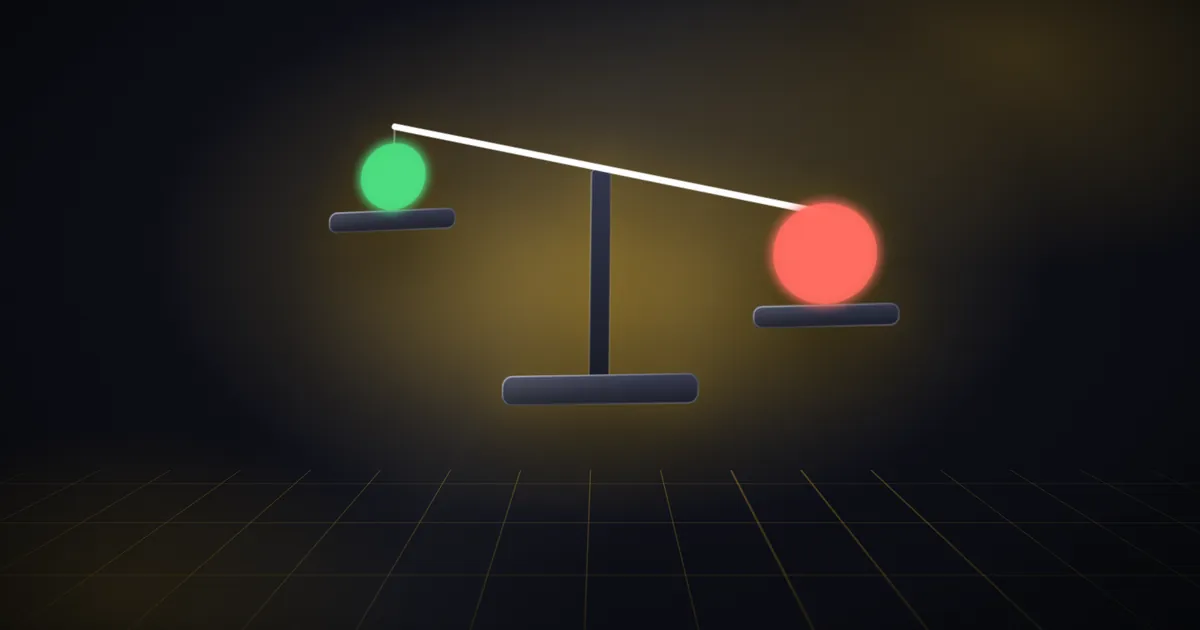
Loss aversion is the tendency to feel a loss more than a gain of the same size. In Amos Tversky and Daniel Kahneman's 1992 experiments, the median participant weighted losses about 2.25 times as heavily as equal gains. When Chicago Board of Trade traders were tested, they showed the related "myopic" form of the bias more than students did. For traders, it shows up as moved stops, skipped setups and checking results way too often.
| Question | Data | Answer |
|---|---|---|
| How much more do losses hurt than gains? | Tversky and Kahneman (1992), experiments on choices between gambles | Median loss-aversion coefficient: 2.25 |
Where the idea comes from
In 1979, Daniel Kahneman and Amos Tversky published Prospect Theory: An Analysis of Decision under Risk in Econometrica (vol. 47, no. 2). It became one of the most cited papers in economics and was central to the Nobel prize Kahneman got in 2002.
The key idea is that people don't judge outcomes as final levels of wealth. They judge them as gains and losses relative to a reference point, usually where they started, and losses feel bigger than gains. That's why most people turn down a coin flip that wins $110 or loses $100, even though it's a positive bet on average.
In 1992, Tversky and Kahneman refined the theory in Advances in Prospect Theory: Cumulative Representation of Uncertainty, published in the Journal of Risk and Uncertainty (vol. 5, no. 4). From their experiments they estimated two numbers that still get quoted everywhere:
- the median loss-aversion coefficient, λ, was 2.25: a loss weighed about 2.25 times as much as an equal gain;
- the median curvature of the value function was 0.88 for both gains and losses: each extra dollar matters a little less than the one before, in both directions.
- 01Gains
Risk averse: take the sure gain · Risk seeking: buy the lottery ticket
- 02Losses
Risk seeking: gamble to avoid a sure loss · Risk averse: buy insurance
A visual summary of the article's table — not a performance chart or a new backtest.
The fourfold pattern
The same paper describes a "fourfold pattern" of attitudes toward risk:
| High probability | Low probability | |
|---|---|---|
| Gains | Risk averse: take the sure gain | Risk seeking: buy the lottery ticket |
| Losses | Risk seeking: gamble to avoid a sure loss | Risk averse: buy insurance |
For a trader, the bottom-left box is the dangerous one. Facing a likely loss, people would rather gamble on getting back to even than take a smaller, certain loss. That's exactly the decision behind moving a stop or adding to a loser.
Myopic loss aversion: checking too often
In Myopic Loss Aversion and the Equity Premium Puzzle, published in the Quarterly Journal of Economics in 1995, Shlomo Benartzi and Richard Thaler combined loss aversion with how often people look at their results. Their logic: the more often you check your portfolio, the more losses you see, because short periods are negative more often than long ones. With loss aversion, those frequent losses hurt more than the gains feel good, and you end up wanting a big premium just to hold risky assets.
Their simulations suggested investors acted as if they looked at their portfolios about once a year.
For a day trader, that evaluation period can be a single trade, or even a single tick: the most myopic setting there is.
Professionals aren't immune
It's natural to assume experienced traders have trained this out of themselves. Michael Haigh and John List tested that in Do Professional Traders Exhibit Myopic Loss Aversion? An Experimental Analysis (Journal of Finance, 2005, vol. 60, no. 1), running the same experiment with students and with traders from the Chicago Board of Trade.
The result went the opposite way from what a lot of people expected: the professional traders showed behavior consistent with myopic loss aversion more than the students did.
How loss aversion shows up at the screen
- The stop that moves. Taking a small, certain loss feels worse than risking a bigger one for a shot at breaking even. This is the core of the disposition effect.
- The early exit on winners. A small open gain becomes a reference point, so watching it shrink feels like a loss, and you close the trade early.
- The skipped setup after a loss. After a losing trade, the next valid setup feels more dangerous than it is, and you skip it.
- Revenge trading. Once you're below where you started the day, you take more risk to get back to even, the "gamble in the domain of losses".
- Checking results tick by tick. Every wiggle feels like a gain or a loss, which cranks up the emotional cost of normal volatility.
The math it distorts
Loss aversion can make a solid strategy feel bad. Take a strategy that wins 45% of the time, with an average win of 2R and an average loss of 1R, where R is the amount risked per trade:
- Expected result per 10 trades: 4.5 × 2R − 5.5 × 1R = +3.5R.
- But it produces more losing trades (5.5) than winning ones (4.5).
If each loss is felt 2.25 times as strongly, the "felt" result of those same 10 trades is 4.5 × 2 − 5.5 × 1 × 2.25 = −3.4, even while the account grows. A trader who reacts to feelings instead of the record will drop a profitable strategy, or tweak it into one with a higher win rate and worse results.
These are round numbers to make the point, not data from any trader.
Five structural defenses
1. Define the loss before the entry. A stop written down before the trade turns the loss into a planned cost, not a surprise. Bracket orders make changing it a deliberate move.
2. Review in batches. Look at results every 20 or 50 trades, not after each one. Benartzi and Thaler's point applies directly: a longer review period means fewer painful losses to react to.
3. Hide the open result. A lot of platforms let you hide unrealized profit and loss. Watching price against your plan, instead of the money, weakens the reference-point effect.
4. Use a daily loss limit. It takes the "gamble to get back to even" option off the table after a bad morning.
5. Measure in R, not in dollars. Putting results in multiples of the amount risked keeps your focus on the process and makes losses comparable from one trade to the next.
What this means for reading any bias
Loss aversion also colors how traders read research, ours included. A daily bias that's wrong on a given morning sticks in your memory more than one that's right. Judging any read, or any strategy, on its last few outcomes is loss aversion at work. The record over many sessions is the only fair test.
Limits
- The core numbers come from lab experiments with hypothetical or small stakes, not from live trading accounts.
- Estimates of the loss-aversion coefficient vary across studies, people and situations. 2.25 is one well-known median, not a constant.
- The Haigh and List experiment measured a specific investment task, not the traders' real positions.
Sources
- Kahneman, D., & Tversky, A. (1979). Prospect theory: An analysis of decision under risk. Econometrica, 47(2), 263–291.
- Tversky, A., & Kahneman, D. (1992). Advances in prospect theory: Cumulative representation of uncertainty. Journal of Risk and Uncertainty, 5(4), 297–323. IDEAS/RePEc
- Benartzi, S., & Thaler, R. H. (1995). Myopic loss aversion and the equity premium puzzle. Quarterly Journal of Economics, 110(1), 73–92. Working paper version: NBER Working Paper 4369, May 1993. NBER
- Haigh, M. S., & List, J. A. (2005). Do professional traders exhibit myopic loss aversion? An experimental analysis. Journal of Finance, 60(1), 523–534. IDEAS/RePEc
FAQ
What is loss aversion? The tendency to feel losses more than gains of the same size.
How much stronger is a loss than a gain? In Tversky and Kahneman's 1992 experiments, the median coefficient was 2.25: a loss weighed about 2.25 times as much as an equal gain.
What is myopic loss aversion? Loss aversion combined with checking your results often. Checking often means seeing more losses, which raises the emotional cost of risk.
Do professional traders have loss aversion? In an experiment with Chicago Board of Trade traders, the professionals showed myopic loss aversion more than students did.
How can traders reduce loss aversion? Plan stops before entry, review results in batches, hide open profit and loss, set daily loss limits and measure results in multiples of risk.
Research and education only. Not financial advice. Futures trading involves substantial risk of loss.
How this article was made: drafted with AI assistance from the research cited above; facts and figures checked by Gabriel Décarie and Karel Panneton.
The week just closed, summarized, and the economic calendar for the week ahead.